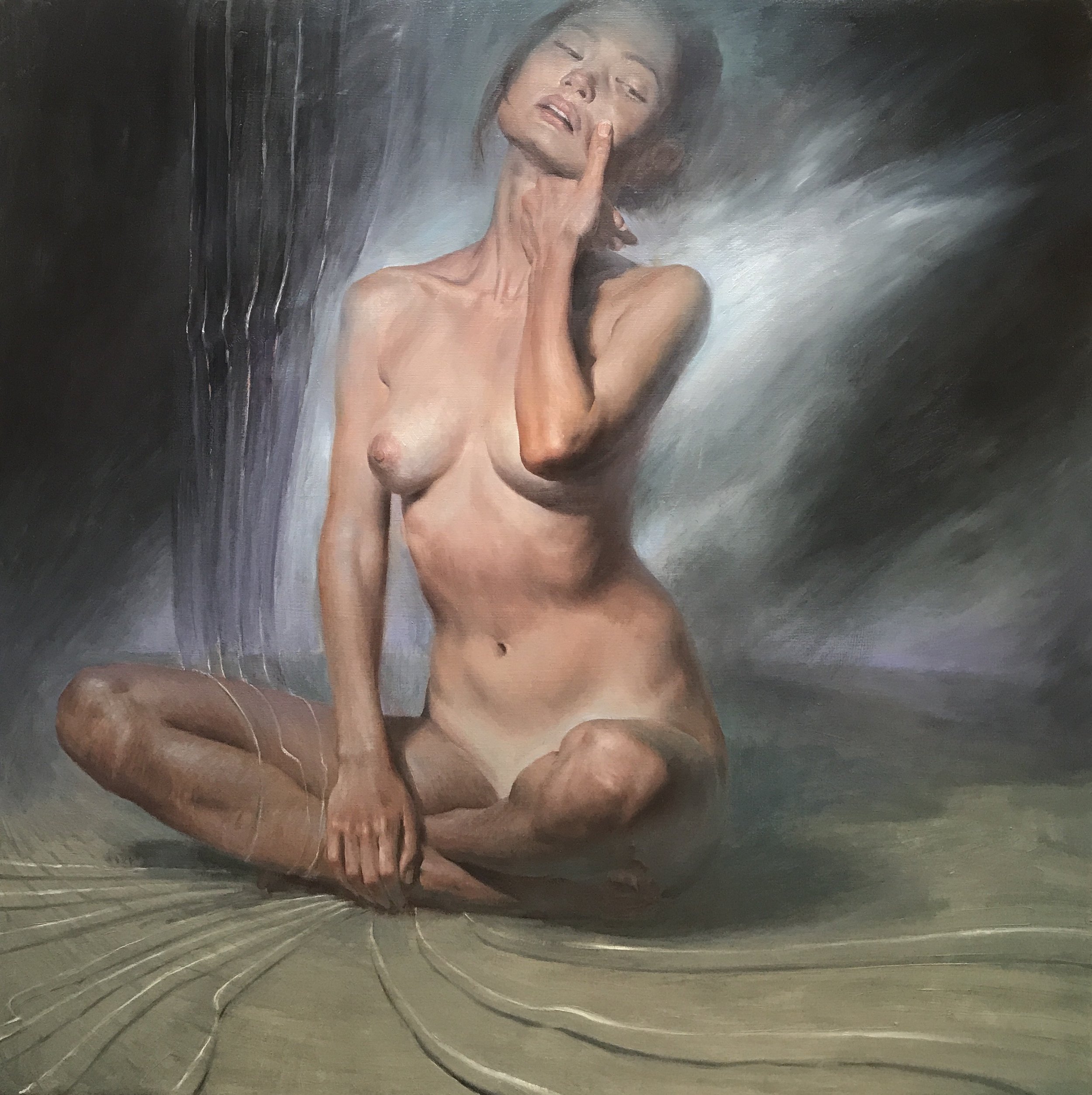
Drawing to Painting: process for my painting "Threads" (now on show at NERAM)

This painting is currently on show at NERAM (New England Regional Art Museum, Armidale, Australia) with the Beautiful Bizarre Magazine curated exhibition “Interconnected” there. On until the 26th of June, details here: https://www.neram.com.au/event/interconnected/

If you are interested in purchasing my work please do so via this link https://store.beautifulbizarre.net/product/scott-breton/ .

As always I very much appreciate your support of my practice!

If you’re in the neighbourhood, the show really is worth a visit: the Interconnected show is full of amazing artwork by Australian artists, the 2021 Archibald is also on show in the museum in the adjacent room, and there is an excellent collection of late 19th / early 20th century Australian works in another room, which includes Streeton, both Nora and Hans Heysen, several Elioth Gruner, Tom Roberts, Norman Lindsay and even an exellent piece by Julian Ashton.

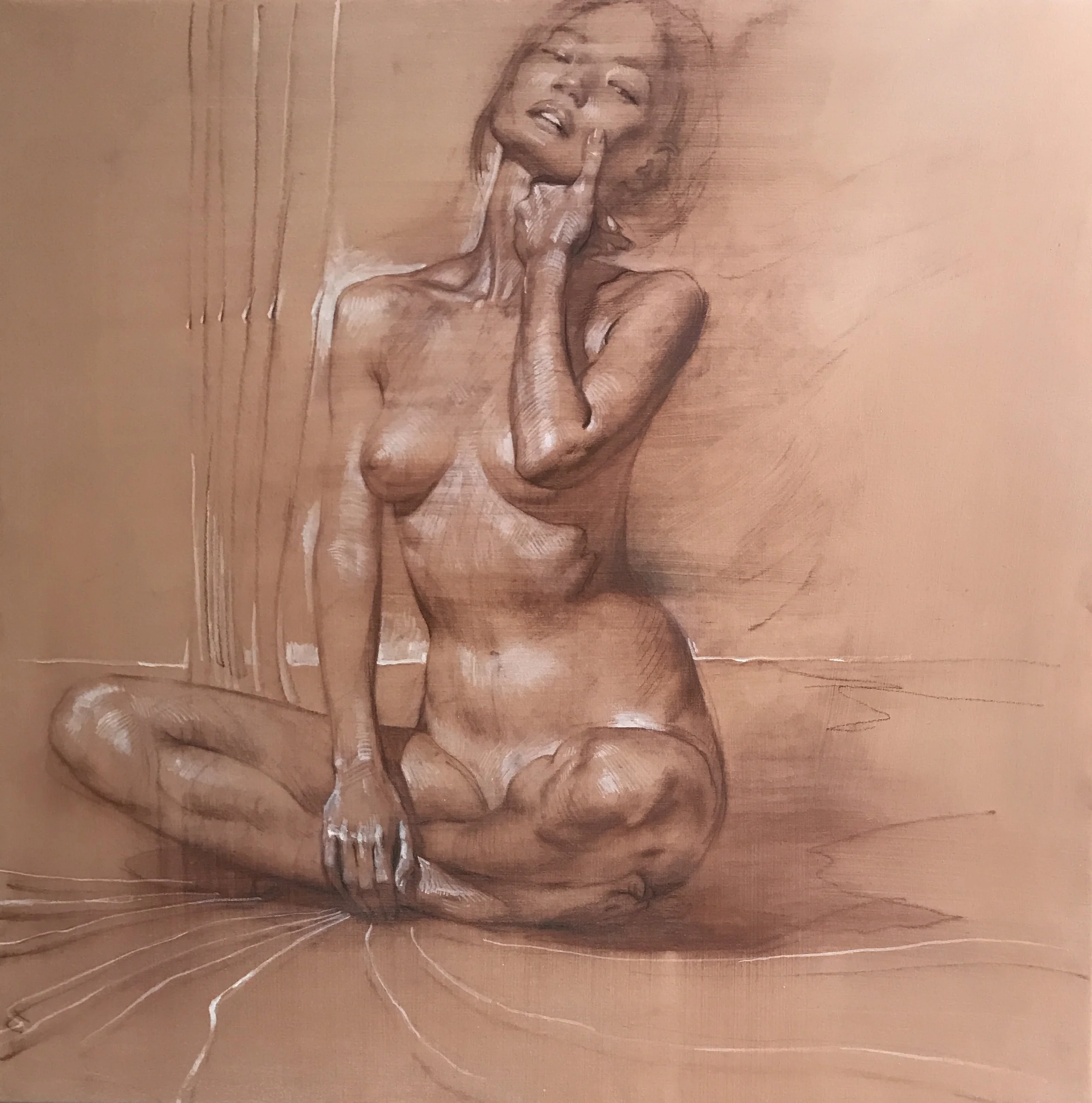
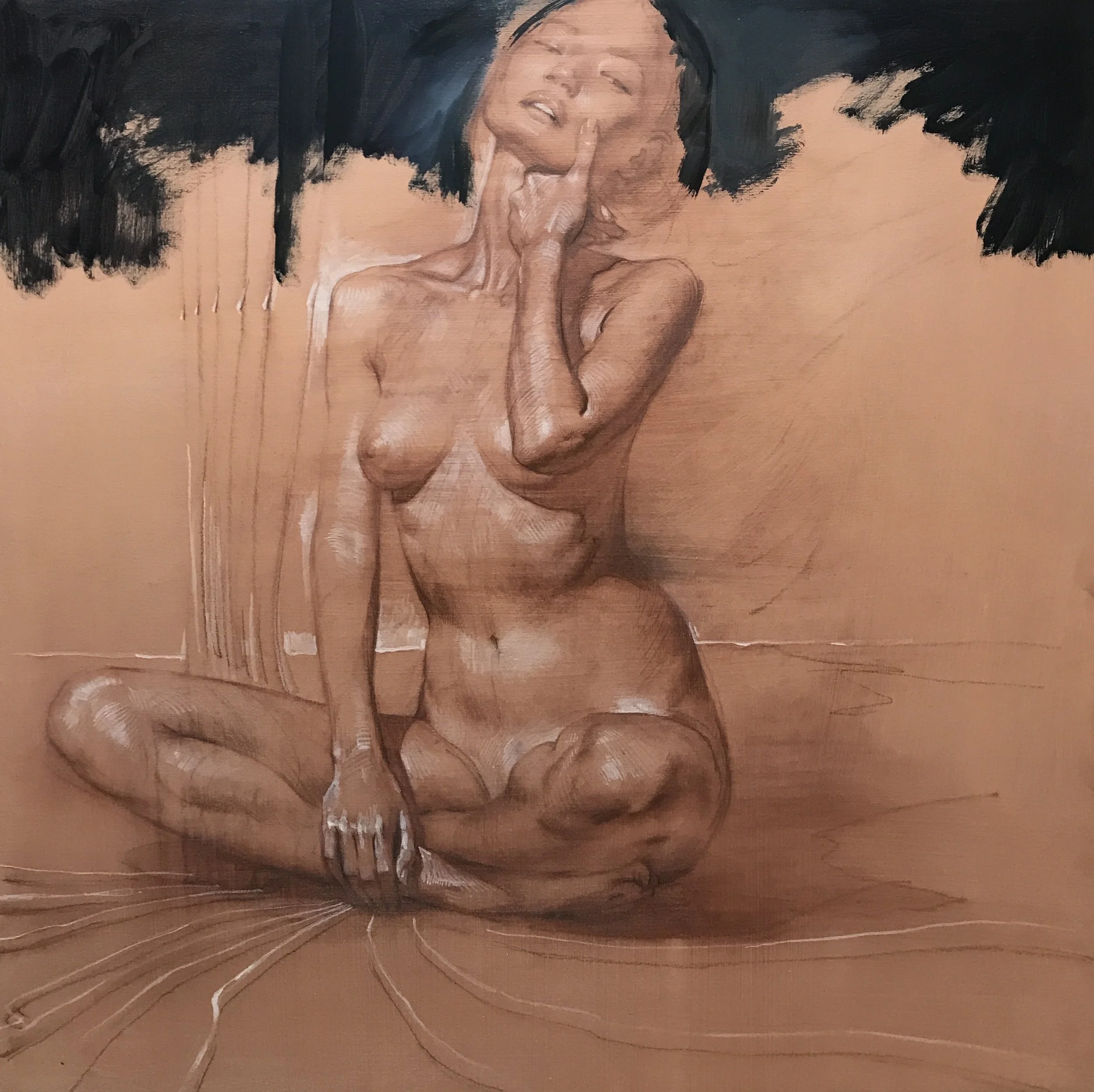
Below you will find a series of images showing the process I used to make the painting.


Process - underdrawing

The way that I work now generally begins with drawing in pastel pencil or charcoal on a warm toned ground, with several layers of gesso applied to smooth the weave of the canvas and make it more organic (I don’t like the mechanical quality of canvas, and even the more subtle and organic weave of Linen can be a bit too insistent under the thinner sections of oil paint).

Pastel pencil sticks well, wiping off less easily than charcoal, and allowing a degree of cross contouring and rendering to develop form and rhythms, though sometimes the transient quality of charcoal is desirable.

I use the line to feel out where to push the drawing, emphasising elements of the gesture, stretching or compressing.

Process - Fresco/19th century style area-by-area painting
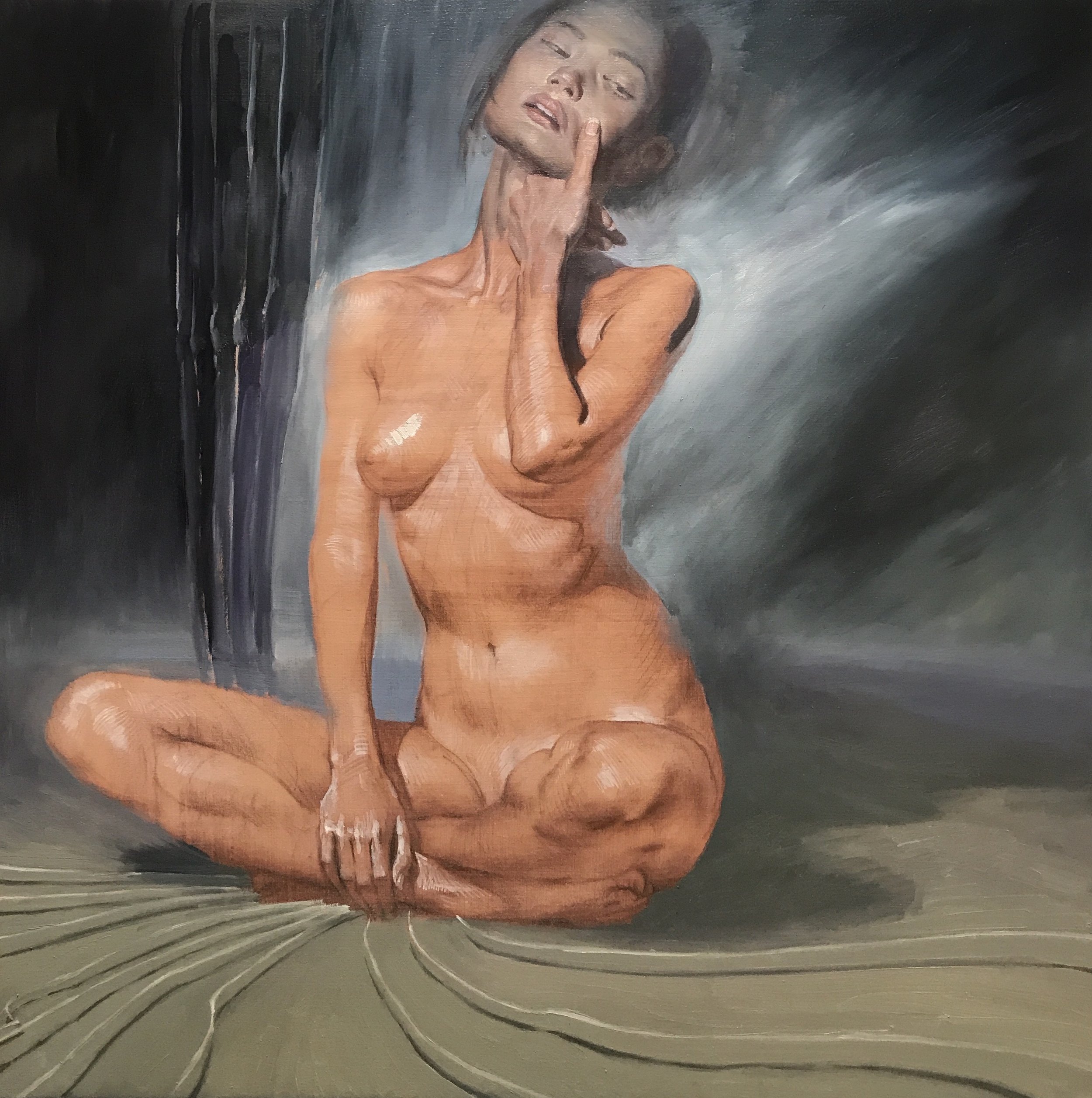
In this case you can see I have simply begun by generally creating a colour context for the figure with a rough background, which allows a fairly direct painting of the figure part by part, a process favoured in the 19th century and also necessarily utilised with fresco painting (which demands finishing an area at a time because one must paint onto plaster laid that morning). I don’t always work this way, sometimes focussing more in terms of tonal impressionism and establish broad general areas rather than thinking primarily about drawing. But this approach suits me because the emphases/exaggerations of the drawing, as well as the rhythms of masses, are the framework out of which the colours and tones will be derived, and provides a guide for the directional application of paint.

In the end, rhythmic, gestural and spatial qualities emphasised/distorted in line point always to composition, to the idea of meaningful integration - with this supported by the texture, colour and physicality of sculpture or painting.

I’ll be writing a separate blog soon about how the emphases that are done during drawing can imply both the interiority of the subject and the artist, and how the sequential caligraphy of marks can transmit this information, stay tuned!

In person class Brisbane:

If you are in Brisbane and wish to do the class with me, which breaks down my drawing process and provides a series of drills to develop each of the elements in your own drawing, you can add your email to be notified when term 3 dates are announced: https://scottbreton.art/notify-me-classical-life-class

Curriculum summary:

https://scottbreton.art/lifeclass

Online Book version of the course:

My online book about drawing can be found here: https://scottbreton.art/full-basic-ecorche-and-gestural-life-drawing-course
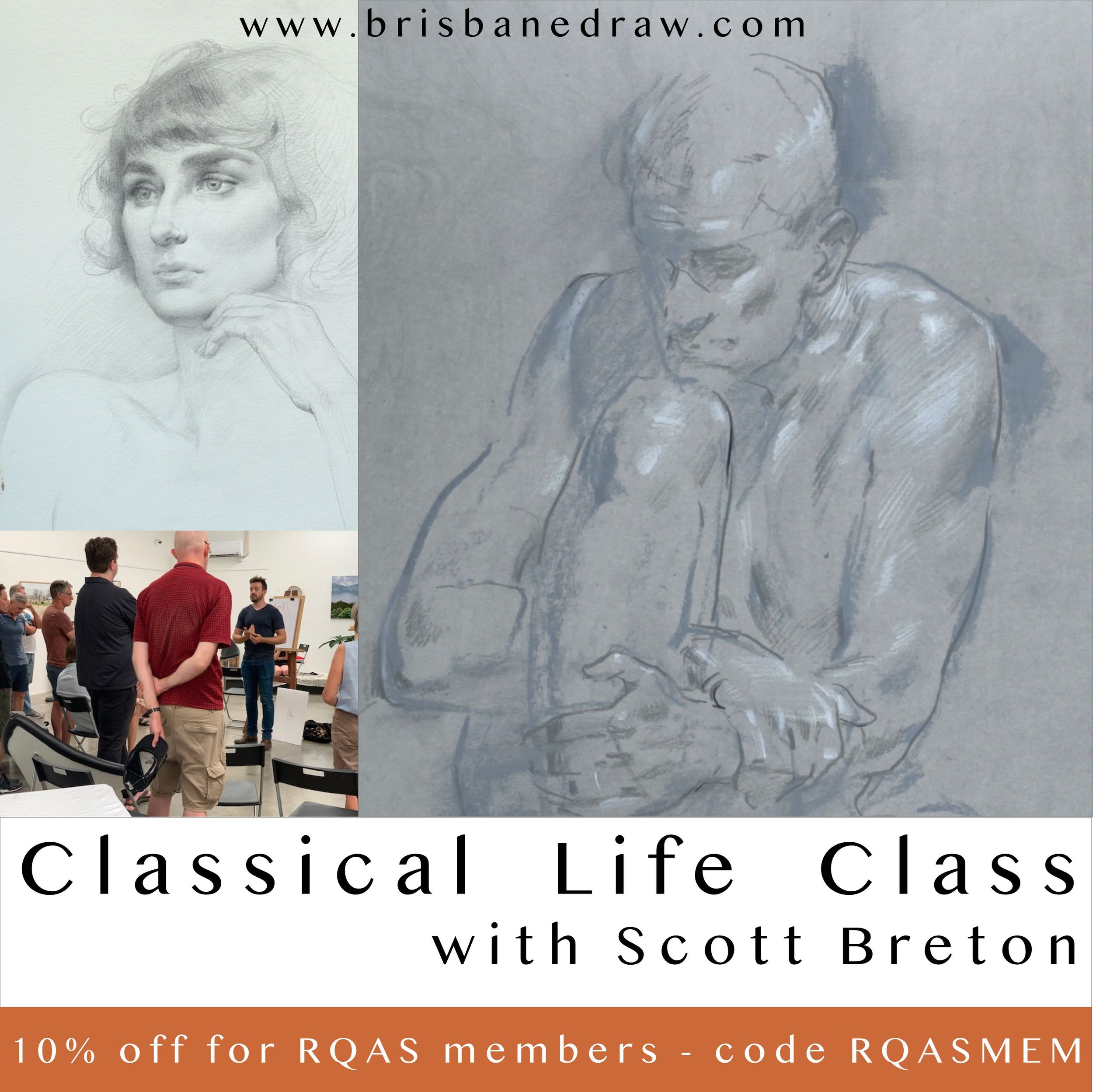
Life Drawings, One spot remains for Class, Beautiful Bizarre curated exhibition

Term 2 Life Class

Starts Thursday 26th May, 6:30-9pm, RQAS. 10 sessions in course (Brisbane, Australia)

Just one spot remains! Book in here www.scottbreton.art/book

(Online version of course here.)

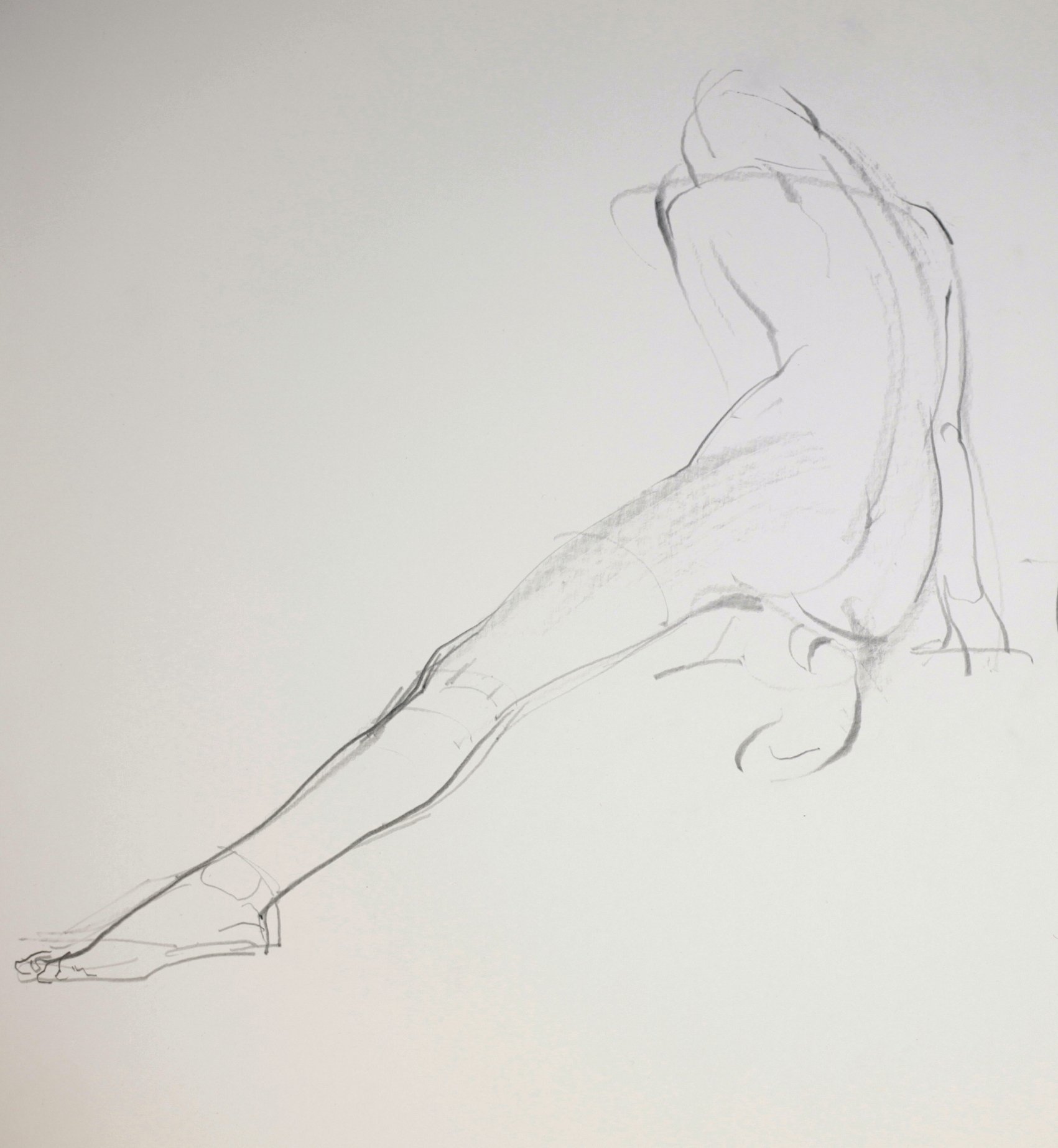
Life model: Mark

3B Graphite block on smooth paper

I want to provide 3 key things in this class:

  1. Enjoyment and support : It can be a scary learning to draw or putting yourself out there in a class. I am doing my best to make class both supportive, comfortable and even fun, despite the challenges in drawing.

  2. Practical : I don’t hold back on giving the best drills and deep feedback I can because I want to empower people to take their drawing to the next level. I’m not providing “Paint and sip” here.

  3. Poetic : What are we doing this for if not to be able to tap into the sense of inspiration, wonder or collaborative expression to be found in working from the life model. The course is designed around the idea of providing tools that will slowly but surely lead to the development of a deep personal aesthetic (not superficial techniques). There is no short cut in drawing, but there are plenty of long-cuts!

Life model: Marie

Graphite block and progresso solid graphite pencil (both 3B) on smooth paper

For more information about what I am teaching go to:

www.scottbreton.art/lifeclass

In the drawings shown I am using a 3B block of solid graphite mainly, on a smooth paper that allows a broad soft mark that can be handled in a somewhat caligraphic way. The pencil is used for refining edges.

There is also one drawing in pale shades of pastel picked out with a dark brown (sepia) pastel pencil which allows even softerd marks.

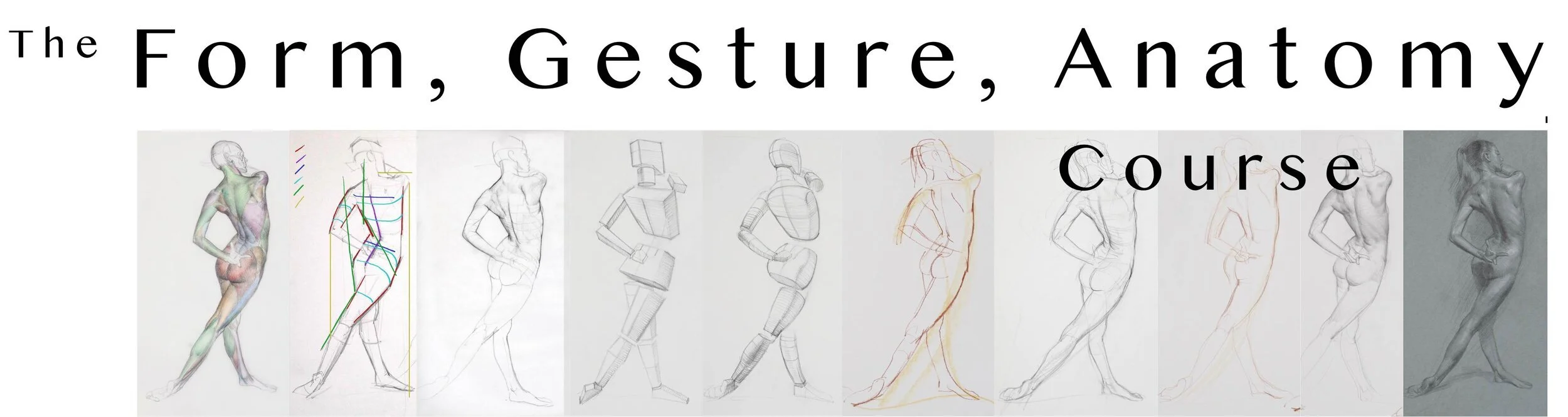
The use of a “calligraphic mark” is discussed in Lesson 7 of the life class (the online version is www.formgestureanatomy.com)

Life model: Cedar

Graphite block and progresso pencil

Chelsea and Lauren

Pastel and pastel pencil

Mark

Graphite block and pencil

Mark

Graphite block and pencil

Cedar

Graphite block and pencil


“Interconnected”

Beautiful Bizarre Magazine Curated Exhibition

70 artists from around Australia

Now on at NERAM, Armidale, Australia

https://www.neram.com.au/event/interconnected/

https://beautifulbizarre.net/2022/05/06/beautiful-bizarre-exhibition-interconnected/

I even managed to get onto some of the posters!

(“Threads” Oil on canvas, 60 x 60 cm)

Met some wonderful artists at the opening last Friday.

For sales enquiries after the opening reception please contact office@neram.com.au. Payment plans are available.

see the painting process on Instagram here:

https://www.instagram.com/p/CcmYyOzPuOm/


Other exhibits at NERAM right now:

The 2021 Archibald is on display in an adjacent room, and a wonderful collection of early 20th century Australian paintings from their collection including Streeton, Tom Roberts, Nora and Hans Heysens, Elioth Gruner and Norman Lindsay.


Don’t forget! The new stocks of the skeleton kit for use with the Form, Gesture, Anatomy Course are now available for shipping worldwide!

Poem: Broken Tree, Bay of Fires (and sketches from location)

Started 2021 during a hiking trip to the Bay of Fires, north east coast of Tasmania

Broken tree, Bay of Fires


And the sea-spray-fine foliage 

bends to the wind,

outcasts driven from the city gate,

refugees huddling across the slope.


And one wiry little trunk reaches up 

in shamanic weirdness,

stripped of most of your leaves,

a madman guide from the other side of drifting sand.

Perfectly half-broken.


Serene as a bonzai, curled like burning paper

with your calm, salt-maddened smile.

Wrapped in shuffling sand, wandering your bending verge 

where two worlds clash.


Vast and savage she reclaims her borders,

again and again and again,

demonically beautiful

clothed in soft painted foam

and grey glare,

hiding her depth under a frenzy of wine-dark horses, 

neck-arched sea-spray manes,

cupped and jostled in the sea wind.


Beside you, a granite boulder, 

shouldered over, bruised by time,

and painted in flames of lichen.

But inside, dark and steady, 

and dense with volcanic memories,

holds and holds and holds and holds

while civilisations rise and fade like days.


Old tree, 

I hear your hermit whisper,

your tales of becoming the energy of oceans in your bent and proud

little holding.  

You grin and tell me that until the final storm you will keep your shifting garden.


Fierce and strange and alive,

exiled from Athens,

stoned by its citizens 

(yet in the night they wonder about your dangerous freedom)

eyes squinted to the wind.

She has beaten you into a knot of strange will, 

a woody vortex made of stinging sand and shrill winds, 

the terrible horizon fused into your broken little branches,

vast arms that welcome her like a lost child.


Further south, Spiky Beach is an extraordinary spot on the coastal highway. I’d like to go back there to begin some serious work…


Update: painting finished in 2025 based on sketches above

Early release - new Form, Gesture, Anatomy Course kit

I am up to the 5th iteration of the model skeleton that goes with the Form, Gesture, Anatomy Course. 15 early release copies available!


To find out more about the new versions, and to order, go here:

https://scottbreton.art/early-release-skeleton-kit

There you can watch this video to see the new iterations that I have recently received from manufacturers, and an explanation of how it works.

I now have two versions of the 5th iteration of kit - one in 4 parts and one in 6 parts. I have some of each that you can order (at the same page)

There is coloured clay also to go with the kit, though of course you might prefer to source this locally - the clay itself is not so expensive while the cost of shipping has increased.


I highly recommend you sign up for the course notes, either as a one time $40 USD perpetual access or $7 per month so that you can keep access for only as long as you need it.

Some new life drawings, how I use studies for paintings, and Brisbane in-person Classical Life Class second term, with a new curriculum summary/ philosophy page

[Not seeing images? Go to www.scottbreton.art/blog to view web version]

Term 2 of my Classical Life Class starts on the 26th May 2022! Brisbane, Australia

Whether you are a beginner or an experienced drawer, this 10 session, in-person course will offer you drills to train and deepen each of the aspects critical to classical drawing. I’ve poured my heart into this, and got amazing results for my students. We break the complexity apart and then put it all back together in a way that is sure to increase your intuitive capacity for seeing and drawing the figure powerfully and sensitively.

It is supported by the extensive online notes and videos of my Form, Gesture, Anatomy Course, which matches the sequence of study. See the curriculum life class summary page for the life class and drawing content of the Form, Gesture, Anatomy Course.

Each class involves a live demo for the class and then one on one tuition as the class is working from the model.

We will cover: three dimensionality, artistic anatomy, accuracy and strategy, rhythm and gesture and rendering (shading), as well as more esoteric and subtle factors in drawing the figure beautifully.

Read the “Philosophy, Practise and Practicalities” essay

https://scottbreton.art/lifeclass#philosophy


Studies for paintings in progress

I have learned over time that for the main figures in paintings, it is critical that I have studies such as the ones you see here to guide me when I am developing the painting. This is partly practical because it allows the gestural theme and sub-themes of the figure to be developed and many of the problems to be solved. It is also a psychological support: there is nearly always an excitement/optimism at the start of a painting that is followed by a period of chaos and discouragement, prior to the resolution forming - by having a solid drawing that I feel good about, I can refer back to this to keep me going through this inevitable chaos/discouragement period.


In-person talk about my life class Saturday, and new 3d models

This coming Saturdy 22nd Jan at 11am I’ll be talking aboutt the in-person version of my Form, Gesture, Anatomy Course

It will be at the Royal Queensland Art Society “Studio Showcase” event, which displays drawings and paintings done at the studio (this is where my offline class is held) https://rqas.com.au/event/studio-showcase-2022/

In my talk. I’ll touch on some of the deeper underpinnings and philosophy, the format of the course and the practical aspects that I have developed to help my students come to a deeper and more fluid grasp on the fascinating practise of Life Drawing.

If you’ve missed out on this term, you can join the list to be notified about next term as soon as it is available. (https://scottbreton.art/notify-me-classical-life-class )

I’ll have a few drawings in the show (see below) and some of the new models I’ve created to help my students to gain intuition for drawing in a three dimensional and gestural way, focussing on the relationships of certain important bony landmarks.

The model you can see me holding, there is a flexible wire between the parts allowing tilt side to side, twist, bend forward and back and also, critically, isolation - a factor that store bought manikins don’t allow:

The model you can see me holding, there is a flexible wire between the parts allowing tilt side to side, twist, bend forward and back and also, critically, isolation - a factor that store bought manikins don’t allow.


I’ve included a few types of media in the drawings I’ve put in the show and different durations of drawing, from a few minutes to about 45 minutes for the one on toned paper.

Prismacolor coloured pencils on hand toned paper

Pastel on smooth paper

Pastel on smooth paper

Red prismacolor pencil on cartridge paper


Finally, I am in the process of getting the new iteration of the skeleton model that goes with the online version of the Form, Gesture, Anatomy Course.

I am finalising the design based on multiple prototypes and hope to have it available in 6-8 weeks. Join the waitlist to be notified as soon as it is available. https://scottbreton.art/join-waitlist


Early bird discounts for my Classical Life Class January 2022 in Brisbane!

Early bird discount! Use at checkout for 10% off until the end of November - Use code: KBYW2R9

(Tertiary students can contact me and provide their student card for a further 7% off - I’ll provide a different discount code to you)

Enrolments are now open for term 1 of my Classical Life Class, a 10 week course done live at the studio of Royal Queensland Art Society, Petrie Terrace, Brisbane, based on my online Form, Gesture Anatomy Course

For full details about the course

Drawing as a meditative practise - a reflection on John Vervaeke's lecture series on mindfulness and meaning

I have recently been enamoured by John Vervaeke’s youtube lecture series “Awakening from the Meaning Crisis”. Vervaeke is an assistant Professor of Cognitive Science at the University of Toronto as well as trained teacher of mindfulness practises. In this series he pulls together many threads from the history of philosophy, theology and wisdom traditions, the evolution of which provide a profound context for the widespread contemporary increase in depression and lack of sense of meaning. I thoroughly recommend the series if these topics interest you because he is one of the most lucid speakers about them that I have heard, combining both a scientific rigour with a practical familiarity with these topics. He clearly has a strong connection to the poetic or spiritual aspect of lived experience.

I wanted to share a reflection on how the type of life drawing I practise might relate to some of the points Vervaeke makes about mindfulness early in the series. I practise a few times a week what I think of as a more classical approach to the discipline of life drawing, which is to say that within the confines 1 minute to about 40 minute poses I am aiming find balance in a range of important aspects - form, design elements, gesture, anatomy, character - and have these compressed into powerful, graceful marks that read true and are sensually enjoyable to the eye. I am distinguishing this from ways of drawing that prioritise, say, more pure abstraction or the expressive mark above other elements.

First, I’ll do my best to summarise the relevant points from Vervaeke here:

In discussing mindfulness, he notes that in the west mindfulness, meditation and contemplation tend to be treated as one thing, but he describes how certain traditions make a clear distinction between :

  1. practices that focus attention onto specific sensory information such as the sensation of breathing - ie getting back to concrete reality in whatever form it takes in this moment

  2. practises of a more contemplative nature that involve an awareness of seeing oneself in a very large, even cosmic perspective.

He suggests that the first practise promotes a way of being that can allow you to get out of mental frameworks, conclusions or patterns of thought that might be only partially correct, in other words opening space for thinking outside the box. On the other hand, the more contemplative practise of the second type encourage a kind of openness of thought that can help with generating new frameworks and connections between ideas that might be elusively far apart . If both ways of being are cultivated, and particularly if one can cycle between them (such as in the physical method of Tai Chi that Vervaeke himself practises) one can cultivate the ability to let go of habitual frameworks and then generate new ones with a deeper connection to reality - in other words to have better ability to gain useful insight as one moves through life, gradually reducing self deception and self destructive habits.

It has occurred to me that the practise of drawing the figure has certain parallels to the states cultivated by the two practise models described above. On the one hand, seeking to draw in a more classical style, involves the continuous study of anatomy as it presents right now in the living human body, in the individual seen on the model stand and the notation of marks aimed at doing justice to the relations seen there. These are concrete, individual observations, but they must be placed into a broader context of anatomy knowledge - in other words the individual observed deepens the generalised knowledge of the anatomy a little bit each time, while this knowledge of anatomical structure allows one to emphasise or de-emphasise as appropriate to make the drawing read. And this is the final arbiter: does it read authentically? Can I honestly say there is a sense of being both generalised and also individual to the drawing?

Similarly, there are patterns of design as well as mass that interact at every level of resolution - from the bones of the wrist and hand, to the whole arm to the whole figure. There are patterns of lines counterbalancing, being in sympathy or opposition at each level. Further, in the poses that I find result in the best drawings, there is a certain overarching theme to the figure - a single central melody or gestalt, which is then tied to specific concrete relationships.

Drawing the figure from life involves the compression of information sensed at multiple levels, from the endless detail of the three dimensional experienced world into a series of potent lines on a flat surface. Practise deepens the information that is sensed - not only in terms of accuracy but in the depth of relation of mass in space, line, and anatomy, and the intention of the figure so that the power of these lines can likewise be gradually cultivated. And so, I don’t see life drawing as only rite of passage for the art student, or something to be attempted every now and then - it is an ongoing practise that not only can bring joy and flow in the moment, but is part of gradual cultivation of the ability to see both in terms of concrete specifics and deep connections.

In the video below, you will see some examples of drawing the figure that begin with marks intended to generalise the figure to its gestalt - sometimes this is a single line of action and sometimes it is a combination of a few curves that in relation to each other capture the most general idea of the intention/design/pattern of the that pose and particular body type. This is followed by marks that attempt to generalise the parts of the figure - the limbs and torso masses, also in relation to each other. The darker marks of the pencil lay in the contours (ie actual edges) of forms, but with reference to the hierarchy already established. In this way, the process is aimed at creating a harmonious hierarchy of relationships between observed concretes and felt, general relationships. It is this flow from general, sensed pattern to concrete specifics that can be so enjoyable and fascinating when drawing from nature, and that strikes me as analogous to the mindfulness training Vervaeke discusses.

So could it be that drawing as a practise is not only enjoyable but also good for your soul?


Do the topics or drawings above capture your imagination?

You might like to do my online figure drawing course at www.formgestureanatomy.com - it is a labour of love that is gradually refined and added to, and you will always have access to the up to date version.

Or, if you are in Brisbane, the in-person presentation of this course which uses the same online material, for more info and bookings go to www.scottbreton.art/book - next 10 session series starts August 26th 2021.

Exhibition of Life Drawings at Brisbane Institute of Art

DUE TO THE CURRENT LOCKDOWN IN BRISBANE WE WILL AIM TO SET UP NEXT WEEK AND HAVE THE OPENING ON FRIDAY 9TH JULY, PENDING DEVELOPMENTS.

For those of you in Brisbane, I will be taking part in a group exhibition of drawings at Brisbane Institute of Art, it includes work by those of us who regularly attend the untutored life drawing session on a Monday night there.

Life drawing Group ad.png

Includes work by David Paulson, Meredith Macleod, Bruce Slater, and others. My drawing above and others will be shown.

Opening at 6:30-9:00 pm on Friday 2nd of July at BIA (Brisbane Institute of Art, 41 Grafton St, Windsor.

Show is up until the 13th of July


New term for my Classical Life Class!

Early bird discount until the end of June: use code “EARLYTHIRD”

For full details, bookings and schedule see www.scottbreton.art/book

Term 3 Classical Life Drawing 10 week course at RQAS

Term 3 of the Classical Life Class I teach at RQAS, Petrie Terrace, Brisbane will begin on the 26th August 2021.

7% early bird discount until the 30th June with discount code: EARLYTHIRD

For full details and to enrol go to: https://scottbreton.art/book

ADC THREE Drawings - At QPAC, Brisbane May 26 -29, new paintings, news, tutorials and tips

Responses to Jack Lister’s “Still Life” Choreography

In the foyer of QPAC, at this production of Australasian Dance Collective, my drawings will be displayed (Queensland Performing Arts Complex, Brisbane, Australia)

Sketches from the development and rehearsal of Jack Lister’s choreography for the performance led to more worked out drawings in the studio.

“THREE” at QPAC, Brisbane 26 -29 May 2021 (Tickets still available at time of writing)

See the drawings, sketches and read about it here.


New Paintings

Click for details, info and sketches


Lucky 13

I was flattered to be included in this article of Sivilisasjonen (Civilization) a Norwegian publication. The author is Bork Nerdrum, film maker, who among other things made an excellent documentary about Odd Nerdrum, his father.

https://sivilisasjonen.no/english/53593/the-worlds-greatest-living-painters/

Note this link seems to be broken on desktop, try on mobile.

 
IMG_8762.JPG

Cost effective solution for photographing drawings

If you’ve ever struggled with getting shots of your drawings where the page is illuminated evenly, you might like to try a pair of continuous light softboxes such as these from Volkwell. They are tunable to a cool, white or warm light and adjustable.

I got them here for $100AUD (about $70USD):

https://www.amazon.com.au/VOLKWELL-Professional-Photography-Continuous-2x20x28inch/dp/B089Q3L546?ref_=ast_sto_dp


Video Tutorials

While the quality of the videos still leaves a lot to be desired, there is still useful information in these video demonstrations of figure drawing that I posted with “Figuary” back in February this year.

These are essentially introductions to lessons 1, 5 and 6 from my Form, Gesture, Anatomy Course


Early bird discount for Brisbanites! And updates to Form, Gesture, Anatomy Course online book

Life class April 2021.jpg

Classical Life Class, Brisbane

For those of you located in Brisbane , Term 2 of my weekly life class starts in April,

Use the discount code LINE2021 at checkout for 7% off until the end of the weekend (ie the end of February)

For full details:

https://scottbreton.art/book

10x Thursday evenings at the Royal Queensland Art Society upstairs studio


Updates to the Form, Gesture, Anatomy Online Course

Video Intros/demos

I have added video intros and demos for the drills from lesson 1, 5 and 6. More will follow in the coming weeks.

Timed Slideshows

Timed slideshows for lessons 1, 2 and 5 embedded in the lesson itself in addition to the existing photo ref resources. The idea is that the poses and duration for the slideshows suit the content of the lesson/ drill well, so you can just load and practise away.

(just go to the table of contents -> lesson number -> life drawing)

Access for $7 USD per month

of $40 USD for one time outright payment

Is the concept of "Fine Art" still useful? Video of Panel Discussion at RQAS Brisbane

My statement (5 Minutes on IGTV):


Full Discussion on Youtube:

The origins of the concept of ‘fine art’ -- as opposed to commercial art, decorative art, illustrative art and so on – are historically uncertain. The phrase was certainly prominent in the 18th and 19th centuries though reportedly ‘fell out of fashion’ in the late 1800s, and in the early 20th century was accused of embodying an invalid ‘double standard’ separating art from useful objects. Yet we still have courses and departments of fine art around the world.

The questions before this panel then are:

-Has the concept of fine art so changed over time as to now be virtually meaningless?

-If there are good reasons to maintain the distinction between fine art and other kinds, what are these?

Early Bird Discount: Life Class with Scott - Term 1 2021 from 7th January

Early Bird Discount: enter “DRAW2021” to receive 7% off until the 25th November.

Book
Logistics

The first 8 week series of 2021 will begin on the 7th January and run until 25th February, with optional extension/catchup sessions on the 4th and 11th March.

For beginners to more advanced drawers looking to improve the fundamentals, this course will help you develop:

  1. Volume / 3 Dimensionality

  2. Anatomical understanding

  3. Accuracy of observation

  4. Classical flow and design

life drawing scott breton - 2 copy.jpeg
 

Following the figure drawing curriculum in my Form, Gesture, Anatomy Course, we will be working in the traditional way from professional nude life models.

At the end, you will have:

a solid, classical strategy for approaching the figure

This core strategy, based in the approach of the Italian Renaissance Old Masters will help you prioritise the big things over the small things, so that you gradually cultivate more beautiful drawings, being confident that you are not wasting time and practising an inefficient strategy or bad habits.


Apply this the core strategy to quick gesture studies…

…as well as more extended studies from life


Book now
LOCATION, PARKING, MATERIALS, SCHEDULE

Make your practise work for you - avoid wasting years of recreating the wheel.

And, you can always go back to the drills I teach using the online notes so that you can improve weak points or keep things fresh in the future.

I have seen people at untutored life drawing sessions make the same mistakes continually over years. These have held them back from achieving the type of convincing, beautiful drawings they desire. The drills and core strategy for drawing that I offer here are challenging but they can be a fun challenge! And they will get you drawing well in the fastest way I know how. I’m not holding any information back that could help you.

Examples of the types of drills we practise in the class:

header+no+highlights+FGA.jpg

14 different drills designed to refine the various aspects that go into classical drawing.

“There’s no shortcut but there are plenty of long-cuts!”

Each session is a mix of class demo and 1-on-1 instruction

…and each session is themed, following a carefully thought out sequence of classes to optimise your learning

So who is this course useful for?


As well as figure drawing being a wonderful practise in its own right, what I teach is particularly relevant for compositional design involving the figure. Or even without the figure, since the interdependency of structure, form and flowing connections is key in all types of traditional compositional design.

The course has two additional sessions at the end that you can choose to add on which allow for longer studies and developing rendering/shading (or allow you to catch up missed sessions at a reduced price).

You get three months complimentary access to the online notes of the Form, Gesture, Anatomy Course as well. This includes literally hundreds of illustrations as well as 3D models and instruction from the anatomy component.


An example of one of my figurative paintings directly using the principles and skills taught in this class (“The Geometry of Escape” Oil on Panel 2020)