Go to:
http://flowmaster3.flambweb.com/
To watch the animation (requires Chrome browser I think.)
Go to:
http://flowmaster3.flambweb.com/
To watch the animation (requires Chrome browser I think.)

Some very cool visualisations of a dancer tracked in space with multiple Kinnect sensors and animated so that the captured points levitate then fall to the ground, an effect like sand falling in a stream onto your hand.
Below that is the how they made it video. Maybe a dancer is the best music visualisation after all!
My Monday daytime sessions will continue tomorrow on Labour day 2nd May 2016.
However, there will be a break from class on 9th May 2016.
Class will resume 16th May 2016
My classes will end for Brisbane in 2016 on Monday 27th June, resuming late February/ Early March 2017
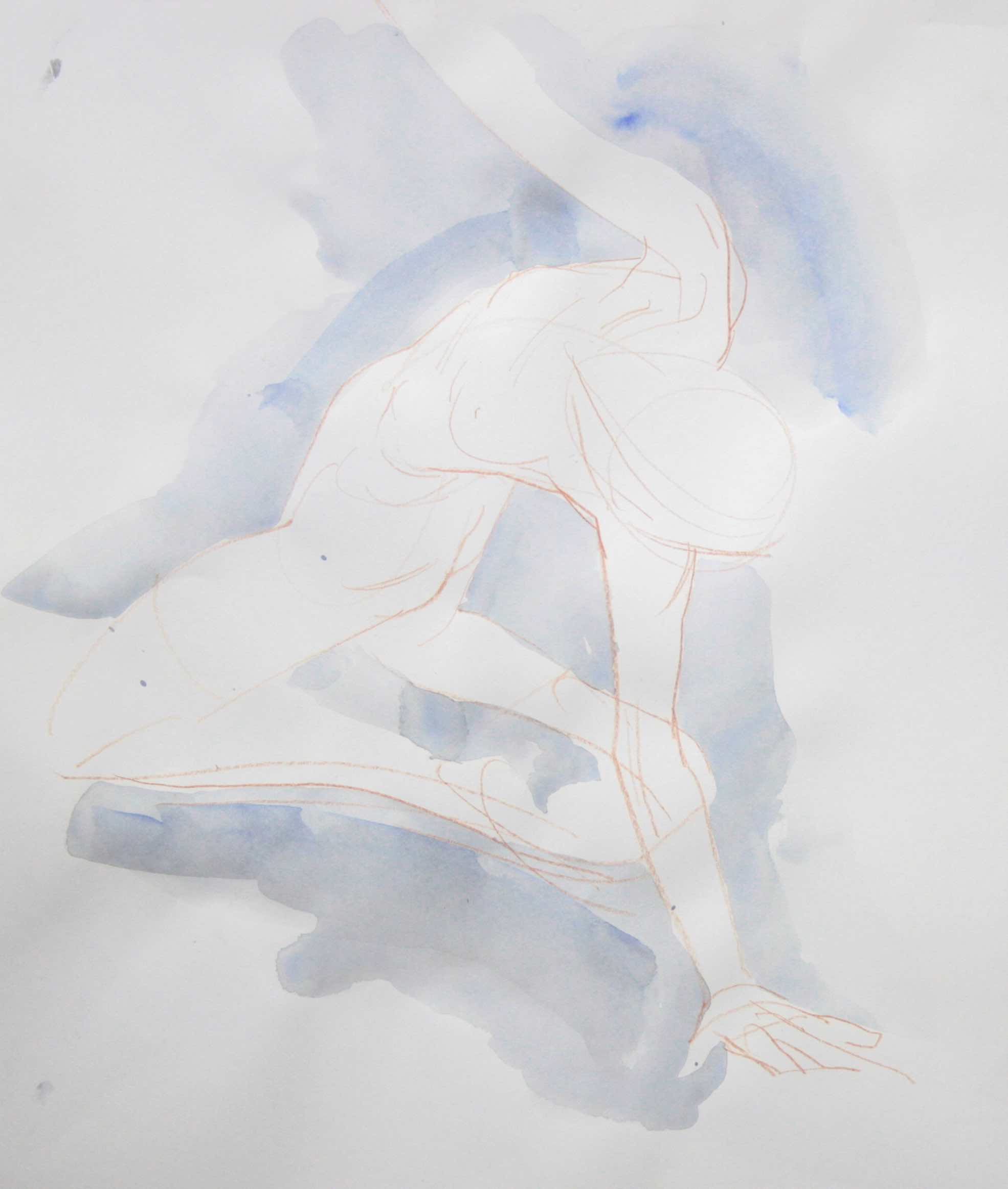
I recently shared the passage and video below with my students of the "Form, Gesture, Anatomy" life drawing and basic ecorche workshop, as wonderful introduction to gesture or compositional line:
On gesture, line and "one buttock playing" (From my Form, Gesture, Anatomy Course)
"Capturing gesture, to me, is the ultimate goal of free hand drawing. The other qualities of accuracy, form, anatomy, and design relationships should be unified by the central melody of the intuitively felt gesture, a vision of the overall story arc of the piece. Developing sensitivity and facility in this field is the goal of the activities contained in this lesson.
Note that there is an important distinction to make here: the term “gesture drawing” is often used today to refer to very short pose - ie 1 to 5 minute drawings, that heavily priortise a sense of action. This is one application of gesture - but gesture is not confined to short, exaggerated studies - it can exist in a fully rendered drawing or painting.
And it is also not limited to the visual arts: in the video below, Benjamin Zander describes the "line" of music in this fabulous Ted.com talk, the capacity of this line to move us and the idea that this line is really the whole point.
Here's to one buttock playing:
Classical Music Visualisations
Here you will find some music visualisations of Bach and Beethoven. There are lots of these on Youtube, of various composers, and for me they make the music so much more compelling - perhaps because I am so visual, the patterns that emerge through these kinds of visualisations help me to understand and enjoy their complex but integrated structures. I really enjoy the use of space in the first two, as opposed to the purely two dimensional visualisations. The third shows a 2D animation that does represent the dynamics of the way the music is played, but I wish someone could develop a three dimensional depiction of dynamic range - could be spectacular.
Bach, J.S. -- The Art of Fugue, Contrapunctus I
Visualisation by Andy Fillebrown
Beethoven 5th Symphony, 1st mvt.
"Fisheye" visualisation by Musanim
Bach, Sonata in C Major, Allegro assai, Lara St. John, solo violin
Visualisation by Musanim
The title is “Singularity Koan”. Singularity here refers to the “Technological Singularity” that has been well discussed in the media. Koan is a type unsolvable riddle or paradoxical saying used in Zen Buddhism to promote a shift in consciousness. Contemplation of the apparent inevitability (whether in 30 years or 300) and concomitant uncertainty of the technological singularity had (and continues to have) a similarly disruptive effect on me - a jolt out of a customary, day-to-day dreary way of seeing the world and my life, into seeing our place in the broad sweep of history, and has caused me to question what is meaningful in my life and human life in general. I have found this to be a refreshing, if startling, effect - much as a near death experience can be.
The title is "Singularity Koan". Singularity here refers to the "Technological Singularity" that has been well discussed in the media. Koan is a type unsolvable riddle or paradoxical saying used in Zen Buddhism to promote a shift in consciousness.
This is the second more developed version, and one that I think belongs in the kind online format provided by sketchfab (and embedded in this blog post). I am currently working on 3d printing a large version of the piece, between 1/3 and 1/2 life size. Here is an image of the model when I changed from a image on the surface of the screens to a relief representation of those images:


I was honoured to receive first prize in the 2016 Harold and Agnes Richardson Memorial Drawing Prize, recently held at the Royal Queensland Art Society
The judge was Russel Craig, Senior Lecturer in Fine Art at the Queensland College of Art, Griffith University.
You can see the show at the RQAS Petrie Terrace Gallery, 162 Petrie Terrace, Brisbane, until the 8th of May
In the photos below I am with my entry and then with my friend and fellow artist Adolphe Piche (http://www.adolphepiche.com/). You can see some of Adolphe's work at right.
"Forward to an Exhibit: II" (1945)
[Here Cummings constructs an imaginary interview in which he connects his painting with his poetry.]
Why do you paint?
For exactly the same reason I breathe.
That’s not an answer.
There isn’t any answer.
How long hasn’t there been any answer?
As long as I can remember.
And how long have you written?
As long as I can remember.
I mean poetry.
So do I.
Tell me, doesn’t your painting interfere with your writing?
Quite the contrary: they love each other dearly.
They’re very different.
Very: one is painting and one is writing.
But your poems are rather hard to understand, whereas your paintings are so easy.
Easy?
Of course--you paint flowers and girls and sunsets; things that everybody understands.
I never met him.
Who?
Everybody.
Did you ever hear of nonrepresentational painting?
I am.
Pardon me?
I am a painter, and painting is nonrepresentational.
Not all painting.
No: housepainting is representational.
And what does a housepainter represent?
Ten dollars an hour.
In other words, you don’t want to be serious--
It takes two to be serious.
Well let me see...oh yes, one more question: where will you live after this war is over?
In China; as usual.
China?
Of course.
Wherabouts in China?
Where a painter is a poet.
from E. E. Cummings, A Miscellany Revised. Edited by George Firmage, New York: October House, 1965. 316-17.
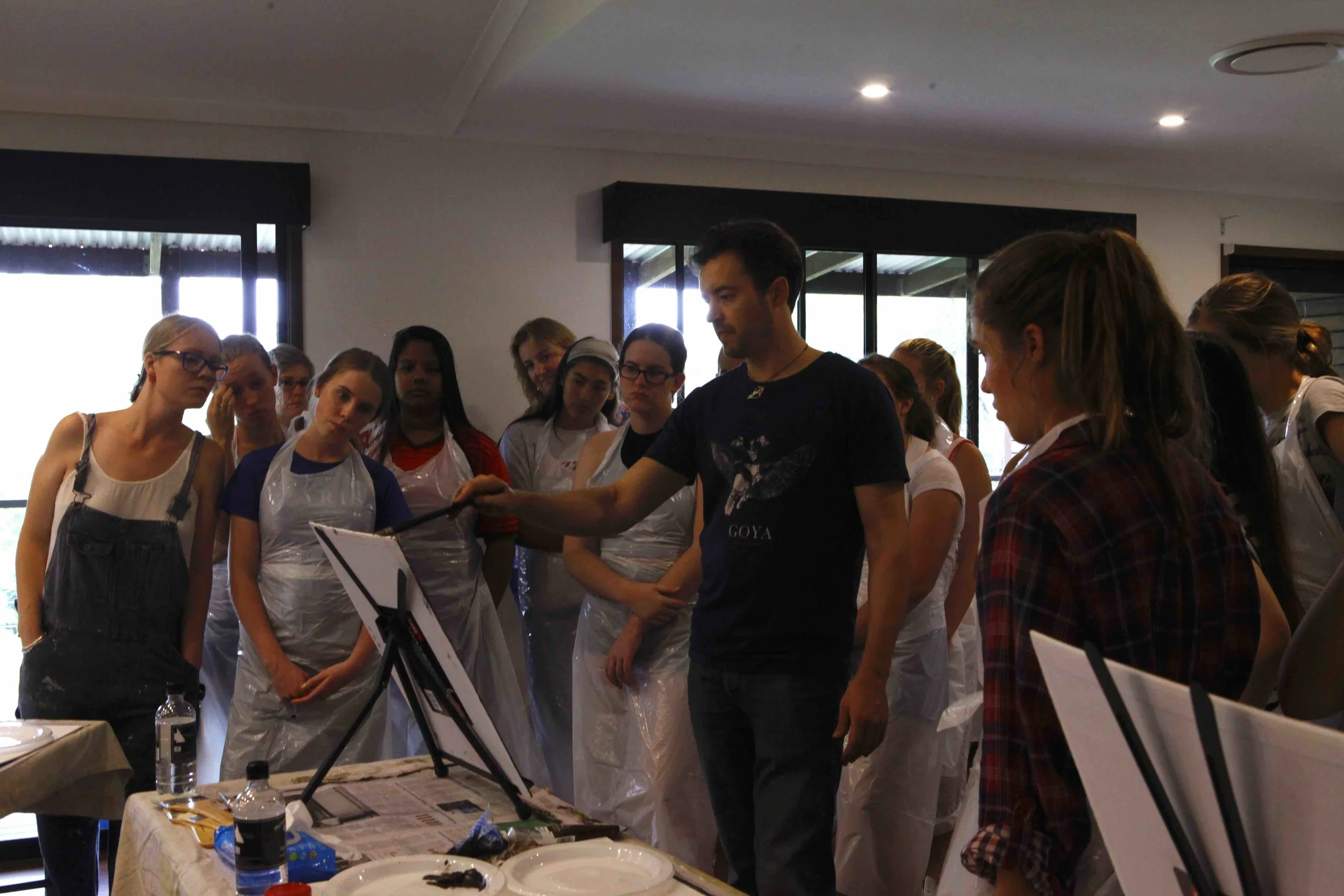
The latest version of my "Form, Gesture, Anatomy" Course got underway on Sunday.
Here are some photos from the day - thank you everyone involved and see you next Sunday to continue!
Enrolment is closed for this workshop but you can be added to the mailing list in the form to the right, to be updated about the schedule for the next session in Brisbane, Australia and Florence, Italy.
For more details and samples from the notes see the Form, Gesture, Anatomy page
For samples of the 3D models used in the notes, go to the blog and scroll down.
In early February, I went to the art retreat for art students entering year 11 at Clayfield College, Brisbane, to deliver a workshop on drawing and painting the figure from life. With the help of the wonderful head of art Madeleine Jones and teacher Samantha Paxton, we had a fun and successful day with a group of talented and enthusiastic students. Thanks also to the terrific model, and also my wonderful and tireless partner Lynn who assisted with the workshop and did all the photography.
If you are interested in having me do a workshop for your school, art group or other institution, please contact me for further information and a quote. You can also find out about my availability in Brisbane, Australia and Florence, Italy, through the year here.
Here are some photos from the day.
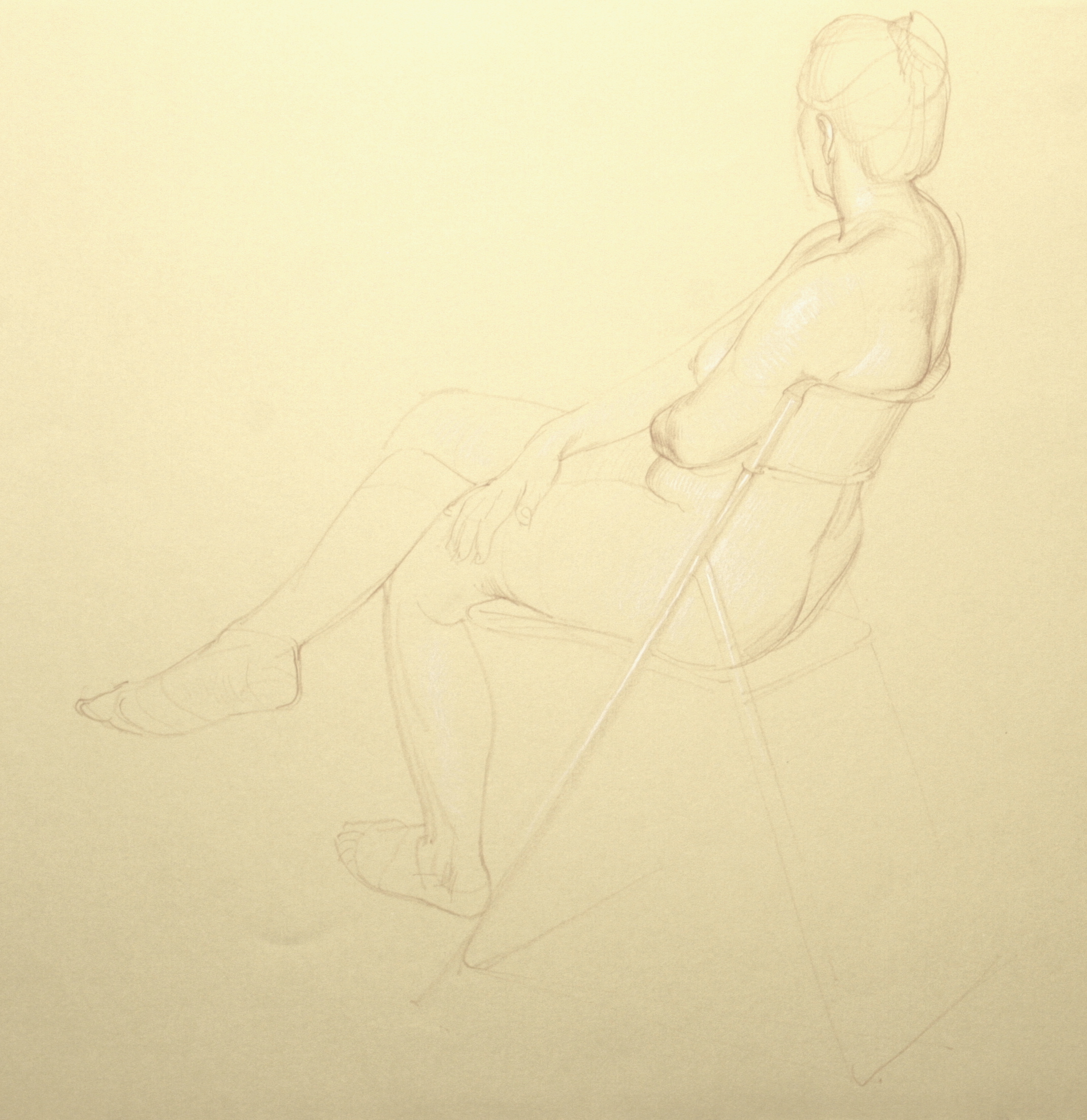
Coloured pencil on paper
As well as the digital 3d models presented in the online notes (embedded from Sketchfab.com as in some of the blog posts below) I like to have physical models that students can hold in their hand and compare to their work. Here are two of the models I have printed for the March 2016 course - one for the deeper layers of muscles of the torso and one of the completed figure. Both will be painted to match the colours used in the course.
Here is a 3D visualisation of a sculpture I posted about earlier in its development.
To read more about the process and meaning, you can view the earlier post here:
http://www.scottbreton.com.au/blog/2015/12/30/work-in-progress-zbrush-digital-sculpt-and-3d-print
This is a sculpture I began in the free version of Zbrush "Sculptris" and then developed in Zbrush as I learned the software. The title is "Singularity Koan". Singularity here refers to the "Technological Singularity" that has been well discussed in the media.
Update: At 17th February 2016 this course is full.
To register for the waiting list in case someone cancels, please register your email address via the contact form.
I will run this course again next year around the same time, after returning from Florence in February 2017.
To be notified of when the next course will run, please subscribe to my blog or like my facebook artist page.
Below are the skeleton armatures for the course. Cast in a strong two part resin, out of a mould taken from a 3d printed prototype that is larger than the last iteration of the course in Florence, are nearly ready... my Undead Army (sometimes called the "Skinny Minions") is coming! Muhahahaha!
Click to enlarge:
For more information about this sculpture and its prototype 3d Print see this earlier post:
http://www.scottbreton.com.au/blog/2015/12/30/zbrush-digital-sculpture-composition-and-its-3d-print
Click to load so you can zoom, pan, rotate etc. For details of controls, click the little eye at bottom right and then click help.
The working title is "DNA to Digital" and is partially inspired by design motifs found in popular culture including sci fi action flick "Tron". I find it fascinating to work in the digital realm and then pull the product of this work into our own physical space through 3D printing (I use a small home printer).
These were rendered using the "light from the eye" approach in which the observed lighting is not represented - instead the light is imagined to project exactly from the eye of the viewer. The observed light and the capacity to "feel" the form in space with the eye are used to understand the form, but the form is modelled using the system - which is inherently spatial and sculptural - rather than visual. I really like to work this way, both in the case of scattered lighting or shiny surfaces (such as shiny bronze sculpture) and because it forces one to think in terms of planes and helps to avoid a more passive copying of visual appearance.
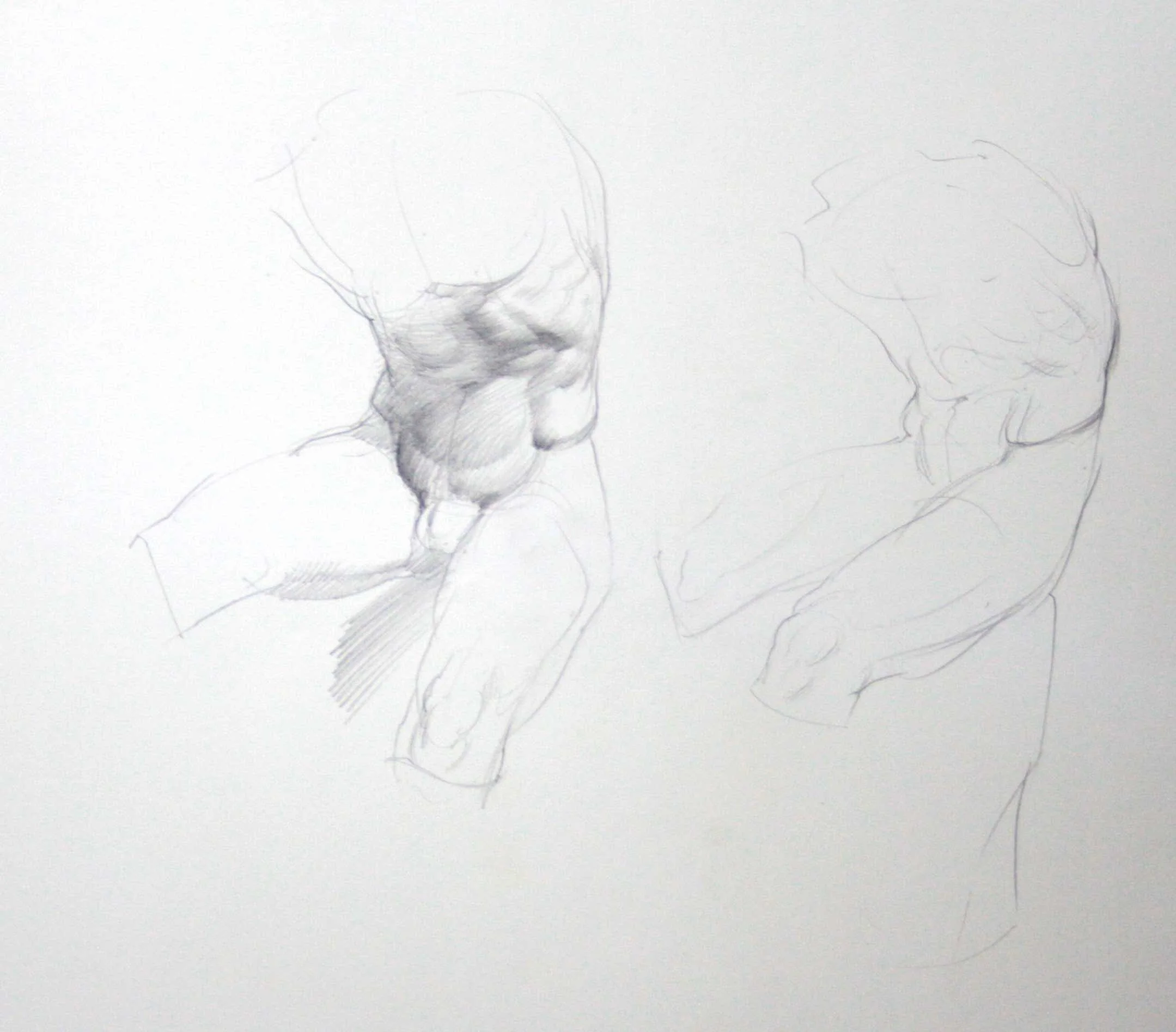
The men pulling ropes are studies for a painting I am composing, thinking about what poses certain figures can be in, getting to know the types of things people do in this action, investigating their anatomy.
The other image is an imaginary form, loosely based on some photographs of ink being dropped into water. Of course, in this case, there was no light to observe in the first place, since it was imaginary, so an intuitive system for applying light and shade consistently is really helpful.



While in Florence last year, I did this portrait study in clay:
I was not able to keep the model or cast it at the time. So I scanned it digitally using the 123D Catch app on my iPad, opened the resulting file on my computer when I got back to Australia. This is a screen capture from Meshmixer of the scanned model:
And a textured 3D model uploaded to sketchfab (that means that the surface colours captured by the photos has been "painted" onto the surface of the digital mesh (you will see more of this type of thing in the classical sculpture captures earlier in my blog) - click to load so you can rotate, zoom etc:
123D Catch scan of a clay life size portrait study of a model from life in Florence, Italy. If you don't know how this works, basically it is an app that lets you take a series of photos of an object from all around and the server crunches the data into a single model with the colours from the photos applied.
The file was rough but good enough to work on in Zbrush and clean up a bit - here is the model cleaned up, a new base added and uploaded to Sketchfab - click to rotate, zoom etc:
123D Catch scan of a clay life size portrait study of a model I did from life in Florence, Italy. If you don't know how this works, basically it is an app that lets you take a series of photos of an object from all around and the server crunches the data into a single model with the colours from the photos applied.
I then printed the model using my small Up Mini 3D printer. The small model was printed in one piece, while the large one was printed in 8 pieces. The safety glasses are included for scale: